Another blue gradient. Another stock-photo handshake. Another company “redefining what’s possible.” Apparently, everyone got the same memo.
We have more creative tools than ever. Yet somehow, everything is starting to look the same. That’s where brand differentiation and AI design come into the conversation. AI can make just about anything look polished, but looking good and standing out are two very different things.
Your company has its own expertise, quirks, and reasons customers stick around. Your marketing should give people a glimpse of that.
When familiar prompts, templates, and trends guide the creative, AI-generated design can start to feel generic. Brand strategy and human art direction are what turn those tools into something meaningful: creative that looks like your business, tells your story, and gives people a reason to choose you.
Why Do So Many Brands Look Alike?
AI didn’t start the matching-outfit party. Businesses have been borrowing each other’s homework for years. Someone likes a competitor’s website. Someone else wants to look “more modern.” A bold idea goes through six rounds of feedback and emerges wearing sensible shoes. AI can make that process faster. It can also help explore something unexpected. Much depends on what you ask for and what you’re willing to approve. Ask for “a professional ad for an innovative company,” and you’ve described half of LinkedIn.
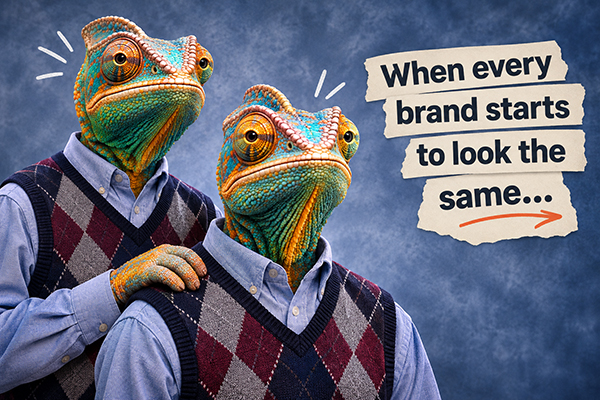
Same tools. Same trends. Same look. Your brand deserves better.
Your Business Isn’t Boring. Your Marketing Might Be Playing It Safe.
You don’t need to sell sneakers or sports cars to have an interesting story. Maybe you make equipment that keeps someone’s factory running. Maybe your team catches the mistake everyone else misses. Maybe customers call you because you actually pick up.
There’s something to work with but put all that under “Quality. Service. Innovation.” and the interesting part disappears. Those words could describe you, your competitor, or the company selling office chairs down the road. If your sales team needs twenty minutes to explain what makes you different, give your marketing a head start.
Same Equipment. Better Idea.
Imagine two ads for a fictional equipment manufacturer…
The first pairs a polished product photo with: “Engineered for performance.” Perfectly respectable. Also available in approximately every industry.
The second says: “Your next shift shouldn’t inherit today’s bottleneck.” Its visual shows the same production snag passing from one shift to the next, like a problem nobody wants to unwrap. Now there’s a recognizable frustration to talk about. The manufacturer can explain how its equipment addresses it, with evidence to back that up. The second direction gives the creative team an idea to build around and the buyer a reason to look closer. Whether it performs better still needs testing.
What Does Human Art Direction Add?
Human art direction connects a business’s strategy to its visual personality. It informs the brand differentiator and shapes what an image communicates, how the words work with it, and what makes the result recognizable as yours. That begins with curiosity. What do customers love about working with you? What drives them up the wall about your industry? What does your team do that deserves more daylight? The answer might inspire an unexpected photograph, a clever animation, or a campaign built around a detail competitors overlook.
AI can help bring those ideas to life. Someone still needs to find the idea worth making.
Give The Good Idea Somewhere To Go.
An eye-catching ad shouldn’t lead to a website that feels like a different company wandered into the conversation. Carry the idea through. Make the relevant information easy to find. Give people a useful next step.
We connect brand strategy, design, technology, and advertising so the creative serves the business behind it. We work alongside marketing teams and businesses without one. We uncover the story, develop the direction, and bring it to market.
Before approving your next campaign, try the logo-swap test: Could a competitor put their name on this and run it tomorrow?
If the answer is yes, there may be a better idea waiting.
Let’s find it. Your brand has spent enough time blending into the herd.
tl;dr
More creative tools. More polished marketing. So why does everyone look so familiar? Here’s where a better idea makes the difference.